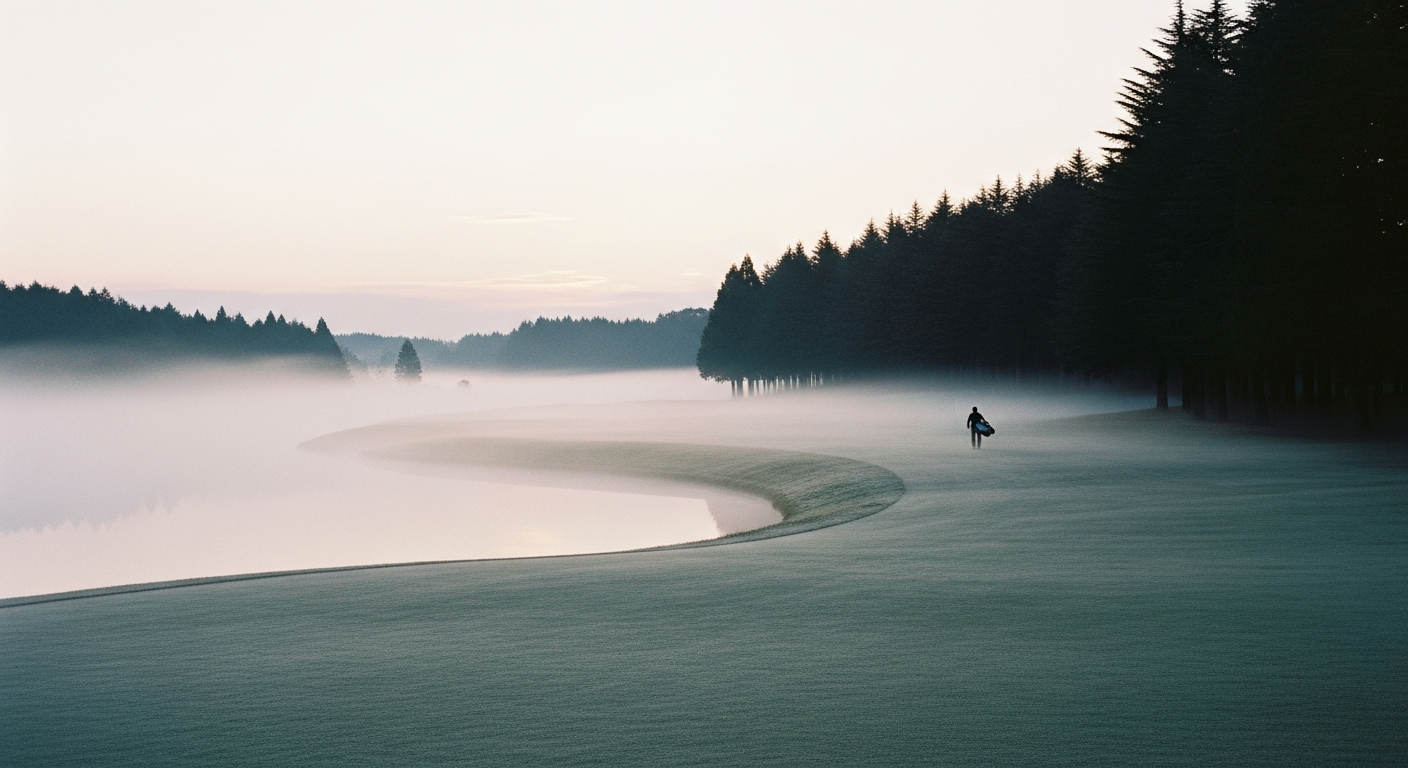
A 150-yard shot, played in clear weather over an open fairway, is almost entirely a matter of club selection. Distance is measured, wind is measured, the ball is hit. The perceptual part of the shot — seeing the green, gauging the space — is quick.
The same shot played in mist is a different shot. A Japanese mountain course in late autumn can sit inside a cloud for forty minutes at a time. The green is there, on a laser rangefinder, but not there in the eye. The fairway edges become suggestions. The trees thirty yards away are visible; the trees a hundred yards away are not.
The shot becomes a perceptual problem before it becomes a golfing one.
What mist does to distance
Visual distance estimation depends on atmospheric contrast — the way objects farther away look paler, bluer, and less sharp than objects close up. Mist collapses this gradient. Far and near objects both look pale. The eye loses its reference points. A green that is actually 140 yards away can read to the brain as 90 yards, or as 200.
Most amateurs, pulled into mist without preparation, overcompensate. They under-club because the green looks nearer than it is. Or they over-club because the green looks unreachable. Either way, the error is in the visual system, not in the swing.
The Japanese adjustment
The adjustment Japanese amateurs make, and that is rarely written down, is to stop estimating distance visually at all. Rangefinder, pin sheet, memory of the hole. The visual check is dropped. The shot is played almost entirely on numbers.
This sounds clinical, and in clear weather it would be. In mist it is the opposite. Letting go of visual distance estimation frees the brain from a task it cannot do reliably, and returns attention to what it can do — feel the swing, control the trajectory, commit. The shot becomes calmer, not busier, once the perceptual load is set aside.
Every serious Japanese player who plays through the autumn has, by January, internalised this. It is not a technique. It is a habit of attention.
The lens
Mist is one of the reasons we list perception as a recurring concern of this editorial. The game is nominally about swinging a club at a ball. It is actually about the several hundred micro-decisions per round that route the swing through a perceptual system. When the perceptual system breaks — because of fog, dusk, unfamiliar terrain, jet lag — the swing has to be routed through a different pathway.
The Japanese course, in its mountain seasons, insists on this rerouting. Hirono in October. Kawana in November. Kasumigaseki at dawn, before the valley has cleared. These are rounds played as much inside the head as in front of the ball.
A course that routinely hides itself teaches a kind of play that a course that does not, cannot.