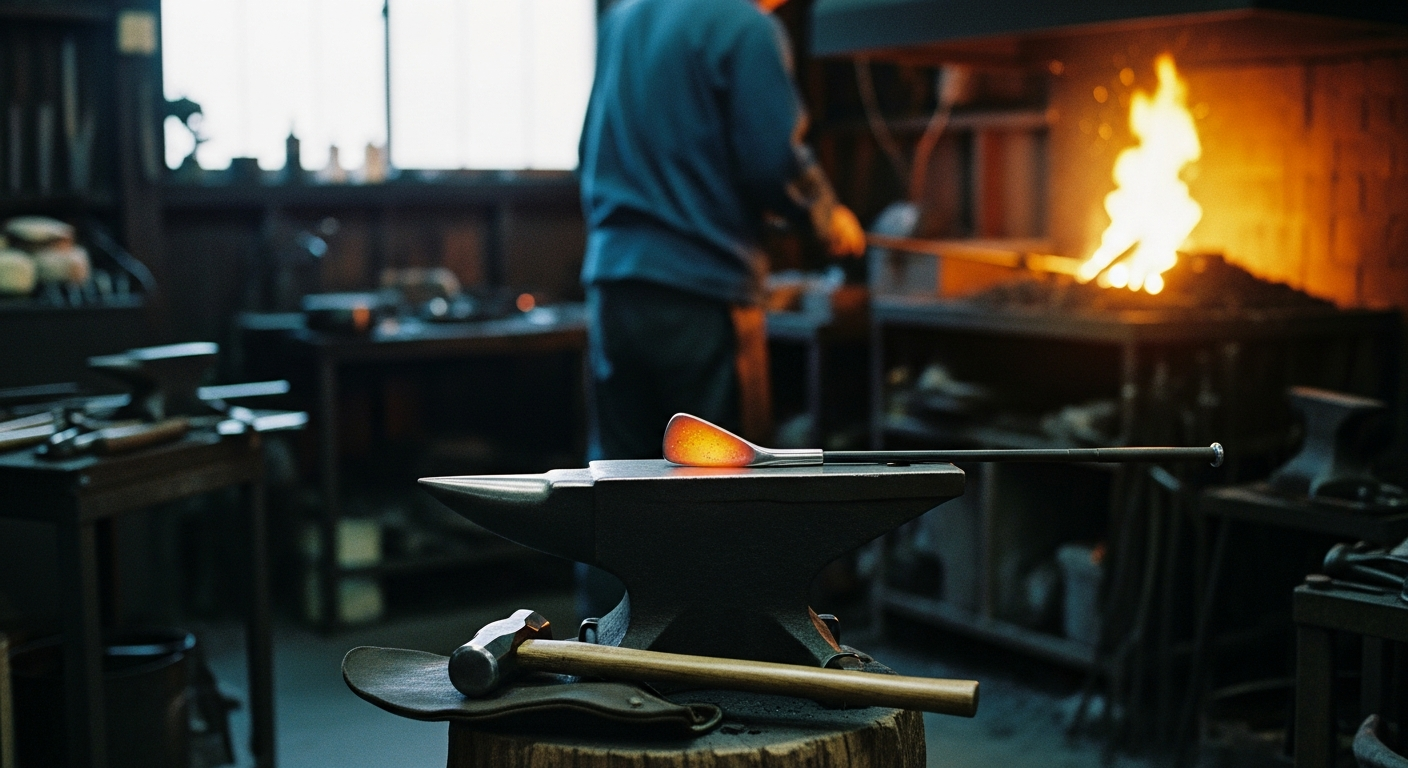
If you have ever held a set of custom-forged Japanese muscleback irons and wondered who, in physical reality, made the head — the likely answer is a small building in Himeji, Hyogo, where Katsuhiro Miura and his sons have run Miura Giken Co. since 1957.
Miura does not primarily market to golfers. It markets, almost entirely, to the designers and brands that want a forged head better than they can get anywhere else.
What Miura actually does
The technical specifics are boring, in the right sense of boring. Miura takes a length of bar steel — typically S20C or S25C, both soft carbon-steel grades standard for forged heads — and forges it under successive pressures until the grain has aligned in the direction the finished clubhead needs to absorb impact. The forging is done hot. The subsequent grinding and polishing is done cold, and mostly by hand.
There is nothing proprietary about this process in the abstract. Forged irons have been made this way, somewhere in the world, for a hundred years. What is proprietary is the tolerance. Miura holds weight, centre-of-gravity position, and face-flatness tolerances that most commercial forging houses do not attempt. The finished head is recognisable to a good club fitter by feel before it is recognisable by sight.
Why the OEM work matters
Much of what Miura produces does not say Miura on it. The forge has, across the last three decades, made heads for a long list of premium club brands whose names appear on the final product instead. This OEM work is not a secret; the industry knows. It is also not aggressively disclosed, because Miura’s customers would prefer it not be.
The result is a strange commercial architecture: Miura is, in any given season, responsible for a non-trivial fraction of the world’s highest-end forged iron output, and is also largely invisible at retail.
Where Miura is visible — the irons sold under the Miura name directly — the product is a short list. A muscleback. A small cavity. A few wedge options. Each iteration is revised slowly. The catalogue changes less in a decade than a major brand’s catalogue changes in a season.
The restraint
Miura does not run the kind of tour staff programme the major OEMs do. Players on tour who play Miura heads — and there are always some — pay for the heads themselves or receive them through individual relationships rather than endorsement contracts. The forge is not set up to subsidise visibility.
This has a brand-theory reading (restraint signals quality), but it is also more straightforward than that. Miura is a forge run by the people who forge. There are no communications people at Miura. There is a list of things the forge does well, and a short list of dealers who carry the product. Anything else is someone else’s problem.
What the head feels like
A Miura forged head, struck on the sweet spot, gives back a sensation that is often described as soft but is more accurately described as coherent. The ball leaves the face without the secondary vibrations that appear in cast or lower-tolerance forged heads. You feel one event, not two.
This is, for a certain kind of player, the reason the Miura name matters at all.