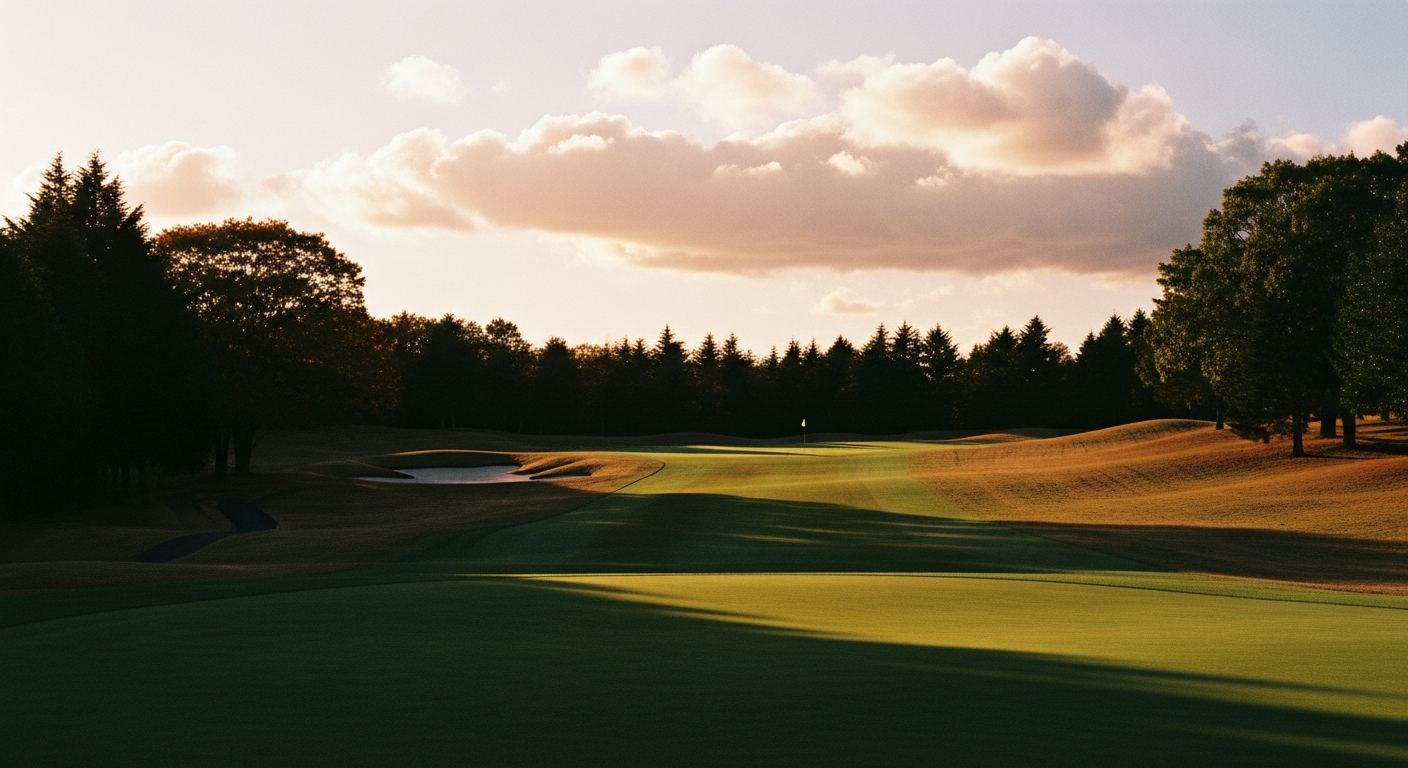
The East course at Kasumigaseki Country Club opened in 1929 and has, in the nearly a century since, quietly carried more of Japanese golf’s ceremonial weight than any other course in the country. It hosted the earliest Japanese amateur championships. It held the 2020 Tokyo Olympic golf event. It remains, on any given Tuesday, a working members’ course.
It is also the course on which Charles Alison’s Japanese work essentially began.
Fujita and Alison
Kasumigaseki was originally laid out by Kinya Fujita in the late 1920s. Fujita was not a professional architect; he was an industrialist who had learned the game abroad, loved it, and taken on the design as a civic project. What Fujita drew, he drew competently. What the club recognised — and what helped bring Alison to Japan — was that competent drawing would not be enough for a course of championship ambition.
Fujita did not work alone. Shiro Akaboshi — the older of the two Akaboshi brothers who shaped the first decades of Japanese golf architecture — collaborated on the routing and was instrumental in the course’s early shaping. Kasumigaseki’s later West course is entirely Akaboshi’s, and the East, properly read, is a Fujita–Akaboshi composition.
During Alison’s 1930 visit, while he was also advising on Tokyo and Hirono, he made substantial revisions to the Kasumigaseki East bunkering and green complexes. The resulting course is credited to Fujita, Akaboshi, and Alison.
The Alison revisions are why the deep, steep-faced bunkers on Japanese championship courses have been called Alison bunkers in Japan ever since — placed not to catch errant shots but to discipline the angles of approach. A generation of Japanese bunkering practice was set there.
The two-green system
Kasumigaseki East is also, famously, a course where the Japanese two-green system has been preserved. Two separate putting surfaces per hole — one bent grass, one korai — allowing one green to be played while the other is being maintained or allowed to recover through the seasons.
The two-green system was once the majority practice on Japanese championship courses. It is now the minority. Modern bent-grass strains have removed much of the agronomic reason for it, and many major clubs have converted over the past two decades to single greens. Kasumigaseki East holds onto both. On a given round the player may play to the korai green in summer and to the bent in winter. The approach shot — distance, shape, spin — is not the same shot to both surfaces.
The 2020 Olympics
That the Tokyo 2020 Games, delayed to 2021, were played at Kasumigaseki East was the culmination of a decade of restoration work carried out with the explicit goal of returning the course to Alison’s intent. Tom Fazio II, working with his son Logan Fazio, led the 2016–2020 restoration to widen corridors that had narrowed, rebuild bunker shapes to their interwar geometry, and restore sight lines that modern maintenance practice had softened.
The course the world’s best saw in the summer of 2021 was, in a documented way, the course Alison had drawn in 1930.
Between two wars, and after
Kasumigaseki was built in the last years before the Pacific war, fell into forced disuse through the 1940s, and was rebuilt and reopened in the 1950s as Japanese civic life resumed. It has since held nearly every major Japanese amateur and professional event. Membership has remained difficult. The course has remained, almost uninterruptedly, the national benchmark.
A round there is not a collector’s round. It is the course itself, played the way the club has played it since its restoration.