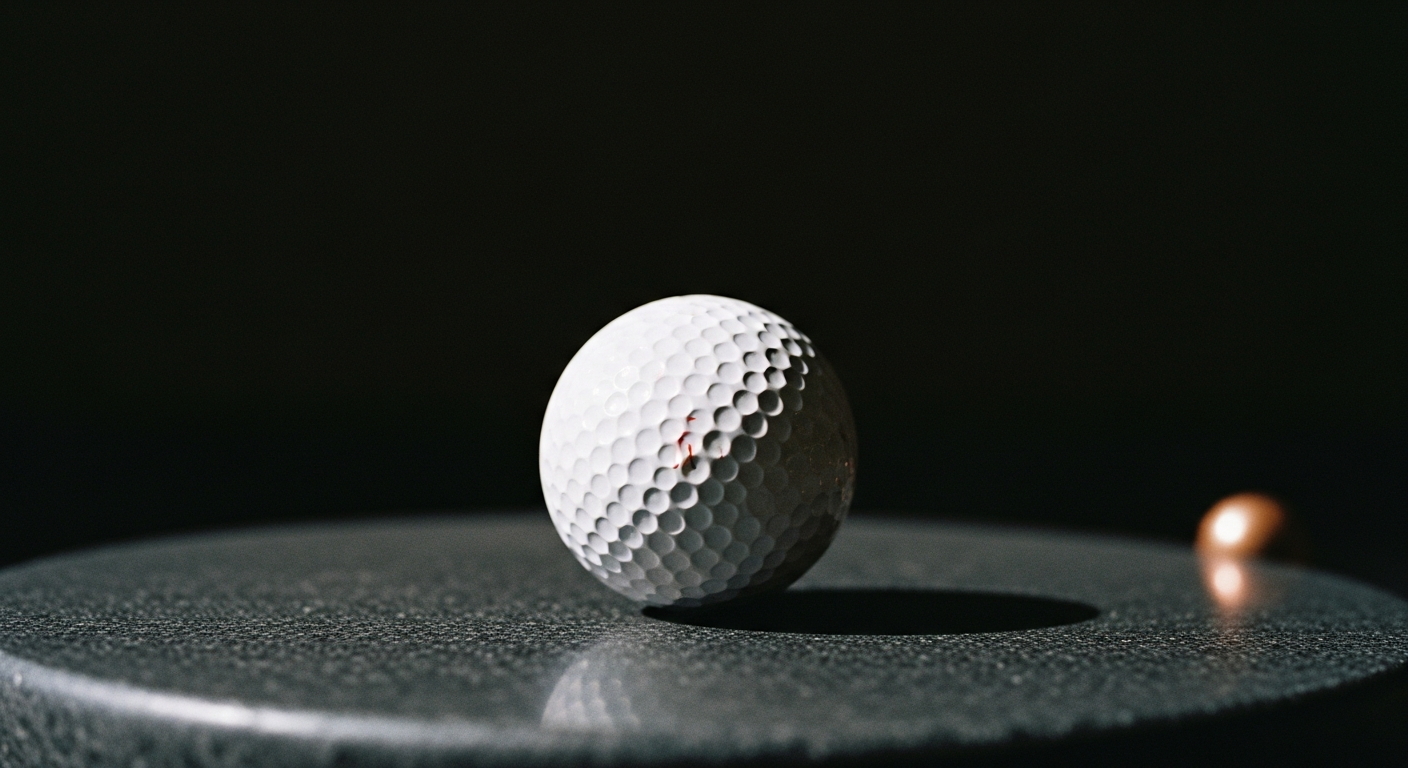
The Srixon Z-Star line has been, since its launch in the mid-2000s, Sumitomo Rubber’s premium urethane tour offering — and the ball on which a steady if rarely loud percentage of Japanese and international tour players have actually played their competitive rounds. The Z-Star Diamond, positioned at the top of the line, is the thinner-cover, firmer-core, higher-spin variant.
What the Diamond designation does — in the ball itself, not on the box — is change the cover thickness and the hardness gradient between the cover and the inner mantle.
What a urethane cover is doing
A modern premium golf ball is a layered object. From inside out: a polybutadiene rubber core, one or two mantle layers of an ionomer blend, and an outer cover of thermoplastic polyurethane. The polyurethane cover is the reason tour-calibre balls generate high iron spin — the material is soft enough to deform around the grooves on impact, generating the friction that puts spin on the ball.
The trade-off is durability. A thinner, softer urethane cover spins more on wedge shots and cuts sooner. A thicker, firmer urethane cover spins slightly less on wedges but holds its surface longer and — critically — produces a crisper sound at impact and a marginally lower spin number off the driver.
What Diamond changes
The Diamond version of the Z-Star specifies a thinner cover than the standard Z-Star and Z-Star XV, with a slightly firmer compound. The net result is higher greenside spin at the expense of cover life. It is an explicit trade-off: more spin around the green, in exchange for a ball that will show wear after fewer rounds.
For a tour professional playing a new ball every few holes, cover life is irrelevant. For an amateur with a tighter ball budget, Diamond is an occasional purchase rather than a default.
Why it plays well in Japan
There is a characteristic of the Z-Star Diamond that is under-reported in the English-language press. The ball is particularly well suited to the spin conditions of Japanese green speeds and Japanese turf types. The standard Japanese summer green — korai or bent, dense, and at a moderate stimp — rewards spin on approach more than speed off the face. A ball that gives up a little distance for extra greenside spin is the locally correct ball.
This is why tour-calibre Japanese players who could, commercially, play any ball in the world often choose the Diamond. It fits the greens they are playing on.
A quiet international following
The Diamond has, over recent seasons, found a quiet following among European and other international tour players whose home greens share spin-receptive characteristics with Japanese turf. The ball behaves, in those conditions, the way those players want it to behave when they need to hold a green. It is one of the clearer cases of a Japanese material product succeeding abroad on technical merit rather than marketing.
Editorial note
We cover the Diamond not because of the brand positioning, but because it is an example of a Japanese material product that has reached — on its technical merit, not its marketing — the upper shelf of the global game. It is the category of Japanese golf object most likely to quietly end up in a serious player’s bag anywhere in the world.