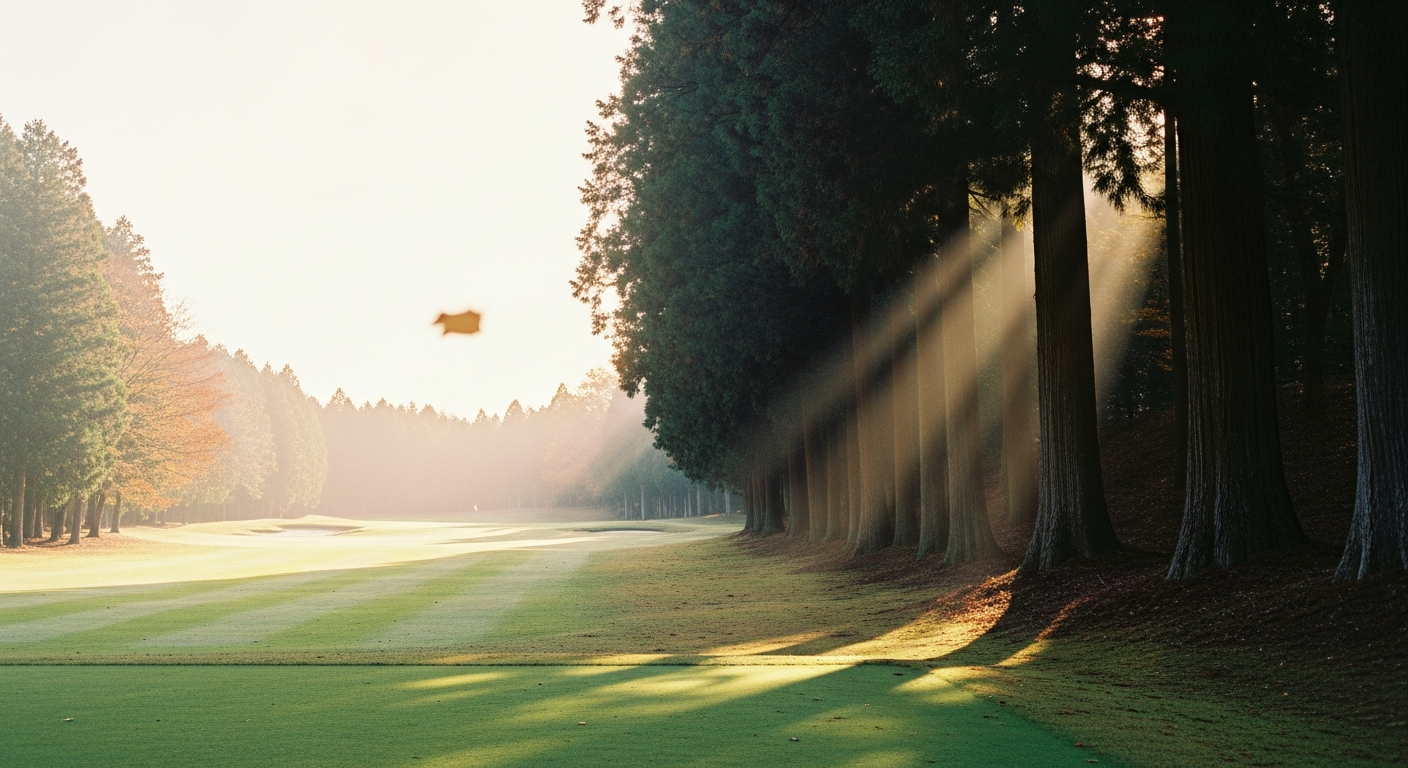
The Japanese cedar, Cryptomeria japonica, is not the tree of an old forest. It is the tree of a planted one. Roughly 40 percent of Japan’s forest area is now in planted sugi and hinoki stands, most of it from the post-war reforestation of the 1950s through the 1970s — cedars and cypresses grown in commercial stands for construction timber, and left in place when the construction economy moved on.
Most of the mountain courses built in that same window of time were carved directly through those plantations. The result is a particular kind of golf corridor that barely exists anywhere else.
A planted corridor is not a natural one
A naturally wooded course — a British heathland, a Carolinas pine — has trees of different heights, ages, and species. Light enters the hole from a dozen angles. A ball hit into trouble can often be found.
A sugi plantation is engineered for the opposite qualities. Trees of the same age are spaced on a grid, grow straight upward, and hold dense canopy. Light enters from above, rarely from the side. The understory is sparse. A ball hit into the tree line falls on a carpet of needle litter that absorbs sound and slightly obscures visibility at the ankle — the most important ten centimetres for finding the ball.
This is part of why the Japanese penalty off the fairway feels heavier than its British equivalent. It is not that the rough is more punitive in the Tour sense. It is that the forest is, by design, harder to play out of and faster to lose a ball in.
What cedar does to the light
Sugi canopy tends to a deep, matte green that, unlike a deciduous canopy, does not shift colour much through the year. The light under it is even, shadowless, and cool. A photograph of a Japanese course fairway taken at 9 a.m. in May and one taken at 9 a.m. in October are almost indistinguishable in tone — a quality that the best Japanese course photographers have learned to lean into rather than fight.
The sound of a sugi-framed hole is also distinctive. Wind moves vertically through the trunks rather than horizontally through a leafy canopy. On a windy day, a Kanto course will hiss rather than rustle.
The cedar problem
The modern issue is that the plantations are past their commercial peak, still standing, and now releasing enormous pollen loads every spring — a national health problem that has become political. Some clubs have begun partial clearance programmes: thinning sections of cedar to diversify the canopy, reduce pollen burden, and restore a more mixed understory. Where this has happened, the course plays slightly easier, looks less photogenic in the traditional sense, and feels noticeably lighter.
Whether to clear cedar is, quietly, one of the more consequential ongoing design decisions at Japan’s classic courses. Every decision to leave a stand of sugi alone is a decision about what kind of course the members want.
The cedar is not a backdrop. For most of the hundred-year Japanese golf tradition, it is the course itself.