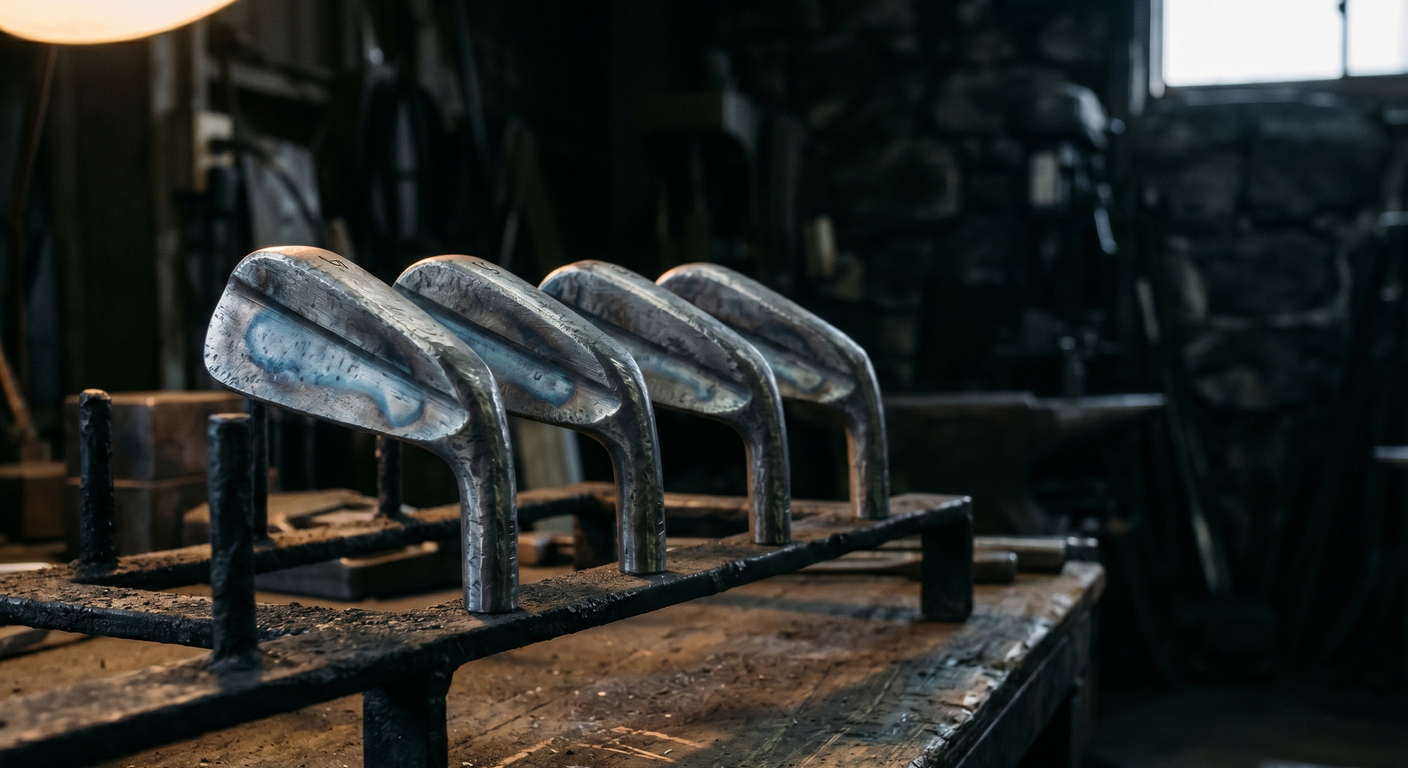
If you have ever held a Japanese forged iron and wondered where the head was made before its retail logo was stamped on the back — the likely answer, for the past several decades, has been a building in Tsubame, Niigata, owned by a company called Endo Manufacturing.
Endo does what Tsubame has done since long before golf existed in Japan. The town is one of the country’s old metalworking centres, organised in the Edo period around nail-making and later refined into a regional discipline of shaping, polishing, and finishing carbon steel. Tsubame’s flatware sits on Japanese tables. Its knives are in working kitchens. Its bicycle parts, surgical instruments, and high-end audio chassis are made by neighbouring shops to the same standards. Endo is the part of that lineage that pays attention to a golf head.
Epon is what Endo calls the small, deliberate line of irons it sells under its own name.
What Endo actually does
The forge’s commercial output is largely invisible to the player. Endo forges iron heads — and, increasingly, certain wedge and wood parts — for a long list of premium golf brands whose names appear on the back of the finished club. The OEM work is not a secret in the industry, and Endo does not pretend it doesn’t happen. It is also not the kind of arrangement the customer brands prefer to advertise, so the relationship sits quietly in the background of the catalogues that depend on it.
The technical specifics are conventional, in the right way. Bar steel — typically S20C or S25C, the soft carbon-steel grades standard for forged heads — is shaped hot through successive pressures, the grain settling in the direction the head will need to absorb impact. The head is then ground and polished, mostly by hand, to tolerances that smaller forges cannot match. What separates Endo from a generic forging house is not the process but the consistency: weight, lie, loft, centre-of-gravity position, and face flatness held to specifications a fitter or designer can rely on across a production run.
This consistency is, in the end, what golf brands buy from Endo when they place an order in Tsubame rather than somewhere else.
Why Epon exists
Most contract forges do not run a retail brand. There is a straightforward reason for this — the customers who provide the bulk of the revenue prefer that the forge does not. Endo is one of the few that does, and it does it carefully. Epon’s catalogue is short. The shapes revise slowly. Distribution runs through a small list of fitters, mostly in Japan, and through a handful of overseas dealers who go out of their way to source the line.
The reading is editorial as much as commercial. Epon allows Endo to make heads to its own brief — heads that a customer brand might not order, because the shape is too traditional, the cavity too small, the sole grind too specific. The Epon line is, in that sense, what the forge would build if no one was telling it to build something else.
The restraint
Epon does not run a tour staff programme. Players who play Epon irons buy them themselves or receive them through individual fitting relationships. The brand does not ship demo trucks to events. Its catalogue does not move with a season’s marketing cycle. The restraint reads, from the outside, as a brand-theory choice. From the inside, it is more straightforward than that — Endo is a forge run by the people who forge, and a small retail line is what the forge can support without distorting the rest of its work.
What the head feels like
An Epon iron, struck on the sweet spot, gives back a sensation that fitters describe with the same vocabulary they use for the best hand-finished forged heads — soft, but more accurately coherent. The ball leaves the face as one event, not two. The secondary vibration that gives away a casting or a lower-tolerance forging is not there. Whether the head says Epon on the back, or the name of one of Endo’s customers, the feel is consistent, because it has been forged in the same building, by people who do this every day.
This is, for a certain kind of player, the reason a Tsubame address matters at all.