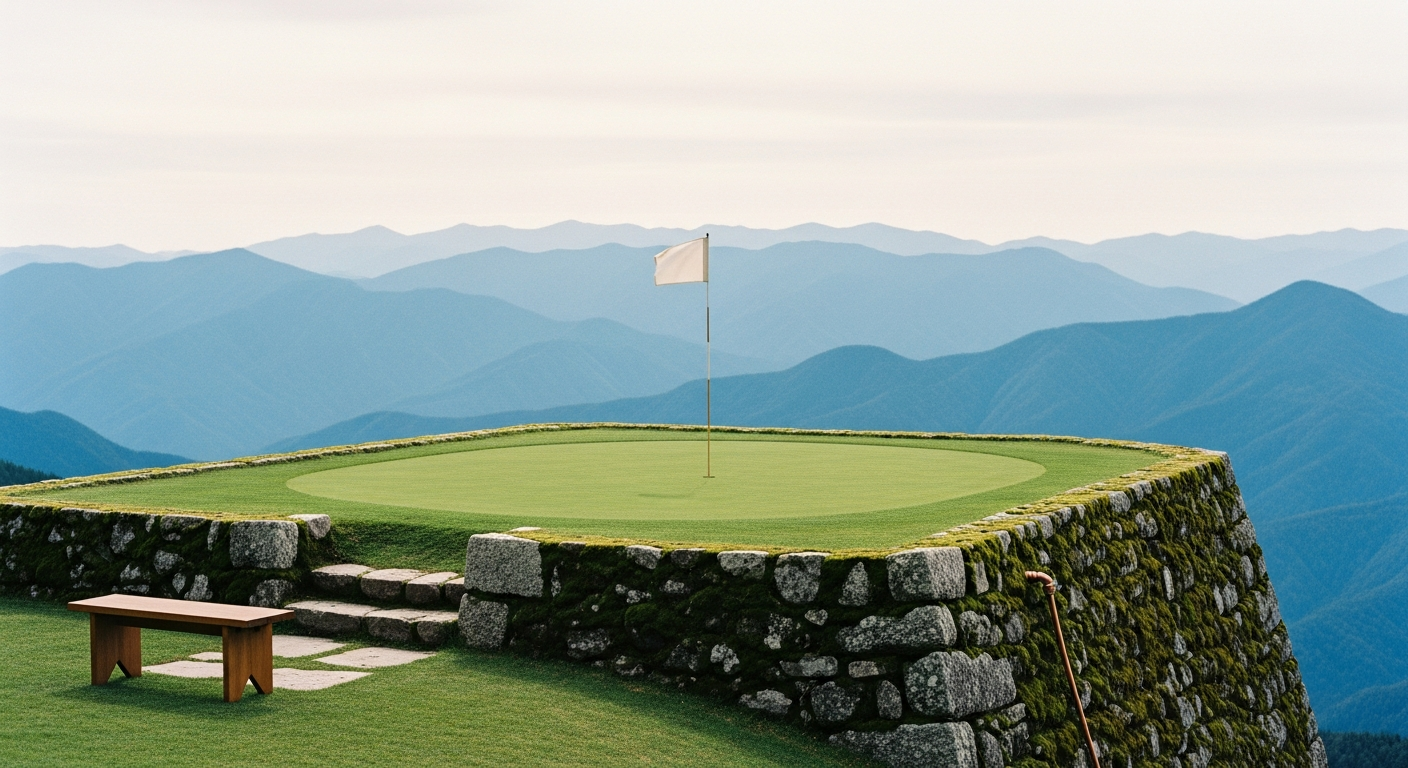
The word course in English first described parkland — the wide, flat commons that stretched beyond an English village, where a ball could be hit and followed on foot. What the Scots and the English invented, they invented on level ground. The first courses in Japan were laid over the ruins of that assumption.
Japan has almost no parkland. The islands are folded, ridged, volcanic, and most of the flat ground that exists is either already under rice or under a city. When golf arrived at Kobe in 1903 and at Tokyo a decade later, there was nowhere obvious to put it. Early designers did not argue with the terrain. They accepted it and built the game onto the slopes.
The ridge makes the routing
What a routing does, in any country, is translate landscape into walkable sequence. In Britain, the sequence tends to be long and linear — one fairway succeeding another along a coast, a river, or a heath. In Japan, the sequence has to fold. A mountain routing climbs, turns, doubles back, and pauses at ridges where the only way forward is a cut fairway through cedar.
This folding changes the feeling of play. A hole does not arrive by slow revelation across open ground. It arrives because the path has carried the player up and around, and then — quite suddenly — the ridge opens, and the green is there. The same green, in a British sense, would have been visible for two minutes. In Japan it is visible for thirty seconds.
A quieter game
A ridge course is quieter than a parkland course in a literal sense: sound does not carry the same way through a cedar canopy as it does across gorse. It is also quieter in a game-structural sense. The pauses are shorter. The next tee is often uphill from the previous green, and the walk between is brief and wooded. There is less room for voice.
Japanese play has absorbed this. The pace on a mountain course, walking, tends to be slightly faster than on a British parkland — not because players are hurrying, but because the terrain compresses the time between shots. The stillness the mountain course is famous for is less a meditative posture than the simple fact that there is less to say between the ridge and the next ball.
The inheritance
What Charles H. Alison, Kinya Fujita, and the first generation of Japanese routings did in the 1920s and 1930s was treat the mountain — which is a constraint — as a compositional premise. The courses they left are not smaller British courses. They are a different kind of course, which happened to be invented because the British kind could not fit.
Almost a hundred years later, the most celebrated Japanese courses still play this inheritance out. A Hirono hole tilts because Rokko tilts. A Kawana fairway turns toward the Pacific because the cliff turns toward the Pacific. Kasumigaseki breathes because the Kanto plateau gives it the room to.
Mountain greens speak quietly because the mountain taught them how.