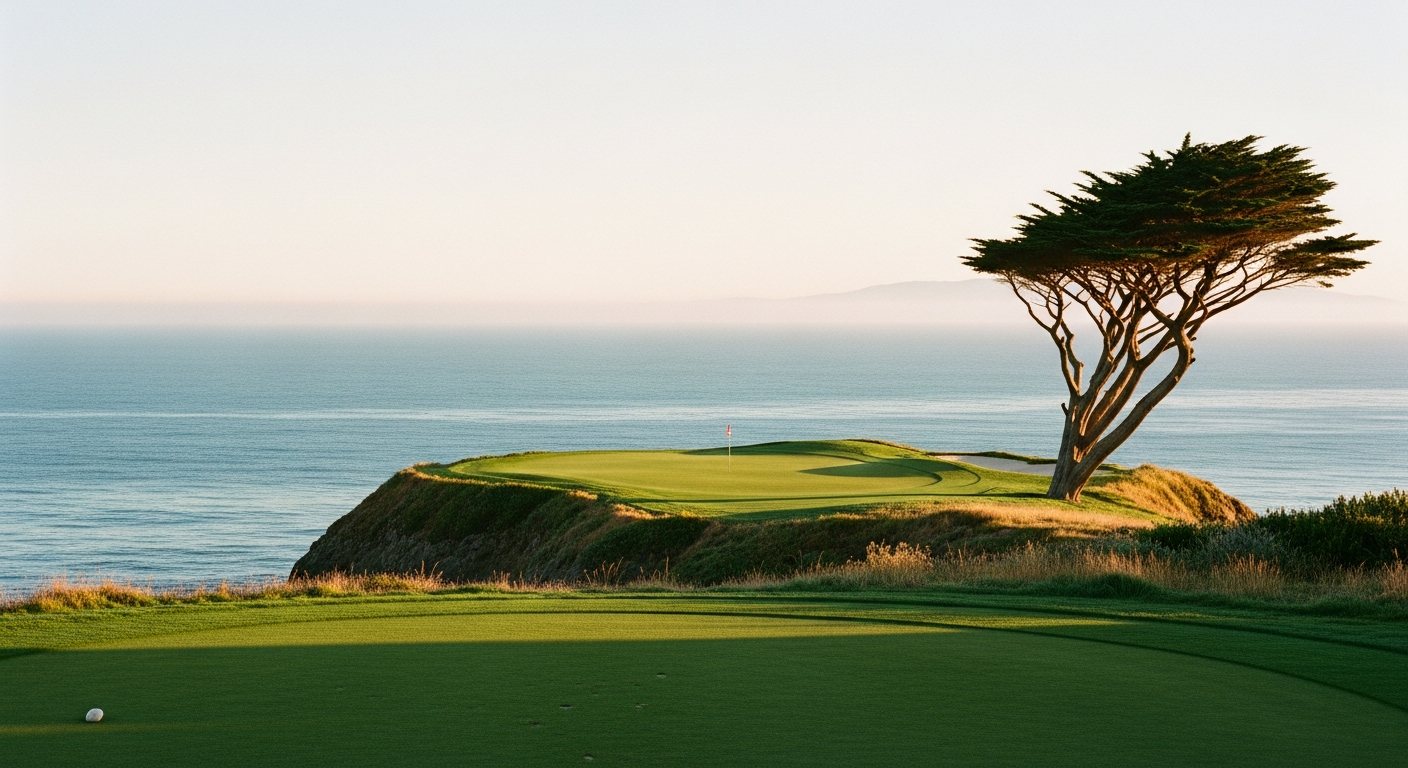
If Hirono is Alison at his most disciplined — a routing that hides its drama under restraint — Kawana is Alison at his most scenic. The Fuji course at Kawana, opened in 1936 on a headland of the Izu peninsula, was not a site Alison had to work hard to find. The site essentially announced itself: a cliff above the Pacific, with Mt. Fuji visible on clear mornings across the bay.
What Alison had to figure out was how not to overplay it.
Kawana’s second course, the Oshima — designed by Otani Kozaburo and opened in 1928 — is a separate composition. This piece is about the Fuji alone.
Restraint on a spectacular site
The trap of a dramatic site is that every hole wants to be the photograph. A weaker architect would have pointed twelve of the eighteen tee shots directly at Fuji. Alison pointed only a handful. Most of the routing turns inland, into pine and broken ground, returning to the cliff at specific and chosen moments.
The result is a course that uses the view the way a well-composed album uses a loud track: sparingly, and in the right sequence. The cliff holes are stronger because the inland holes have been patient.
The signature stretch
The par 5 that runs along the cliff — reachable in two for the long hitter, photographed from a thousand angles — is the hole the course was designed around. What makes it work is not the view. The view works itself. What makes it work is that Alison gave the hole a strategic problem that is wholly separate from the view.
A layup to the ideal angle demands a shot shaped away from the cliff. A go-for-it demands a shot shaped toward it. The cliff is not scenery; it is the hazard. This separation — of view from strategy — is what distinguishes a serious resort course from a merely beautiful one.
Four years on from Hirono
Kawana Fuji came four years after Hirono, and the two courses are often read as a pair. Hirono is inland, forested, and restrained. Kawana is coastal, open, and dramatic. Seen together, they are the two halves of the Alison vocabulary — what he could do with a tight ridgeline, and what he could do with an open cliff.
No British architect working in the interwar period drew two such different and equally successful courses in the same country. That Japan has both is one of the quiet facts of early-twentieth-century course design.
What the site teaches
Kawana is a resort property, and the Fuji course is accessible by reservation to guests staying at the hotel — a characteristic of the property since opening. This accessibility means that Kawana has hosted, for close to ninety years, a steady procession of visiting players who would not otherwise have seen an Alison course in Japan.
What those players come back describing is not the view. It is the pause — the stretch of holes between the cliff sections where the course walks quietly inland, under pines, and lets the Pacific come back into focus only when the routing is ready for it. Alison’s discipline, again. Nine decades on, still holding.