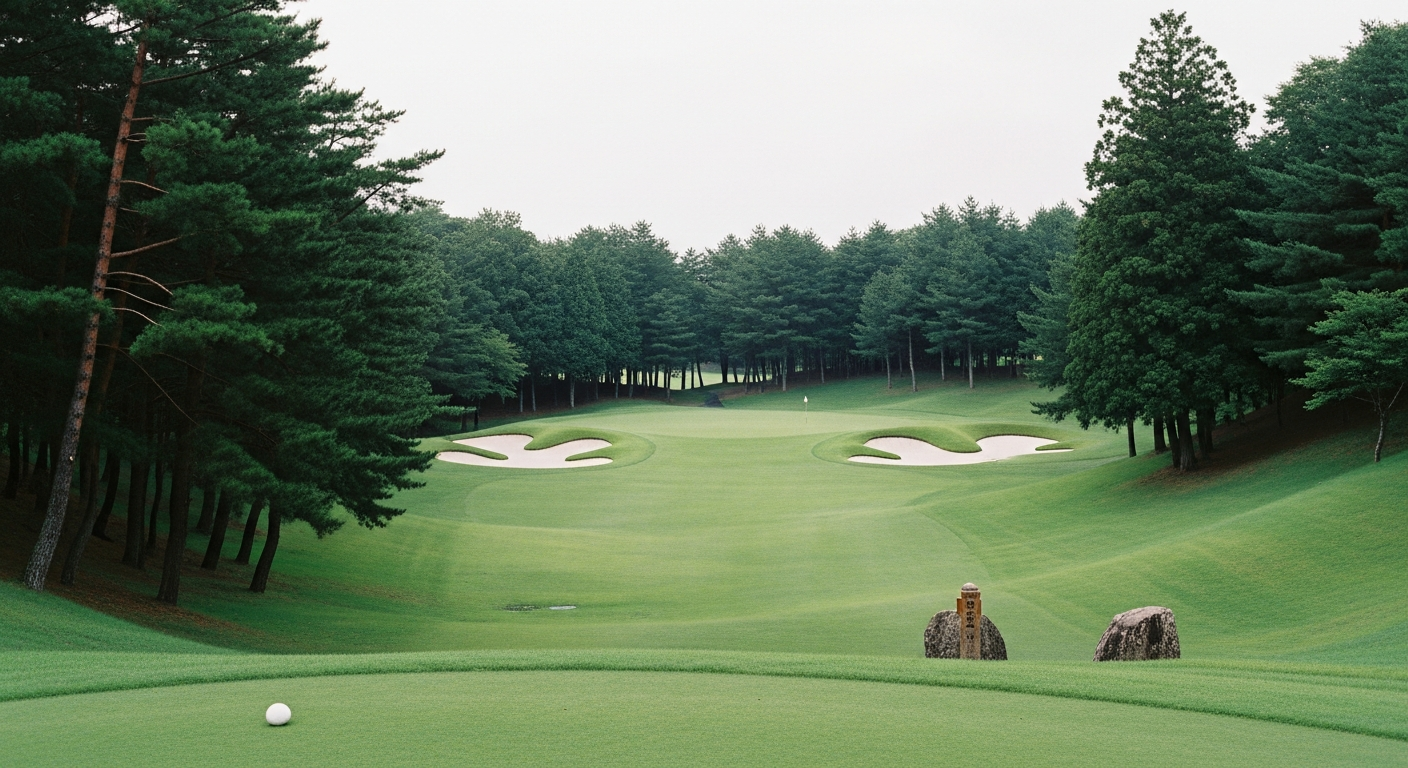
The British architect Charles Hugh Alison arrived in Japan in 1930 to advise on the Tokyo and Kasumigaseki courses, and was asked while he was there to look at a site in the hills north of Kobe. He spent time walking it. What he drew became, almost immediately, the course the rest of Japanese golf would be compared to.
Hirono Golf Club opened in 1932 on land that is in part forested bowl and in part open ridge, at the northern edge of the Rokko mountains, in the hills of Miki, Hyogo. Alison routed eighteen holes through it and never revised the plan. The course he drew then is, in its essentials, the course that is played now.
Reading the ridge
The central quality of an Alison routing, at Hirono more than anywhere else, is that the ground dictates the sequence rather than the sequence dictating the ground. A lesser designer would have cut and filled to flatten problem contours. Alison left them, and arranged the holes so that the contours were the strategic problem.
The short holes at Hirono — the par 3s in particular — are what the course is most photographed for. But the holes that most clearly show what Alison was doing are the mid-length par 4s that tilt across the ridge. A player cannot play those fairways straight. The contour tells you to fade or to bail, and both options are paid for.
Breathing
What Hirono members and visiting professionals talk about is the way the routing breathes — opens at a stretch of short holes, narrows into the forested mid-holes, opens again at the closing stretch. Long holes are paired with short ones. Uphill walks are paired with downhill greens.
This rhythmic pacing is older in British golf than in American, but rarely achieved on mountain terrain. Alison’s solution at Hirono was to treat the Rokko ridge as a breathing mechanism: when the ridge closed around the course, the holes shortened; when the ridge opened toward the Inland Sea, the holes lengthened. The player’s heart rate follows.
Preserved in original
Hirono is one of the few interwar Japanese courses that has not been significantly re-routed. Bunker shapes have been rebuilt. Tees have been lengthened for the modern ball. The cedar stands have thickened. The 2018–19 restoration led by Martin Ebert of Mackenzie & Ebert returned bunker shapes, sight lines, and several hole contours to Alison’s 1932 intent — the most substantial work on the course since opening. But the 1932 routing diagram and a current aerial of Hirono are, hole for hole, the same drawing. Almost no other Alison course anywhere in the world is preserved to this degree.
What this means for the modern visitor is that Hirono is not merely a great course. It is a legible piece of design history — an Alison routing that can still be read the way Alison meant it to be read. Every decision a modern architect has declined to make there is part of what is being preserved.
A membership at Hirono takes a quiet lifetime to obtain. A morning round there, on a misted Kansai October, is one of the few experiences in Japanese golf that is genuinely irreplaceable.